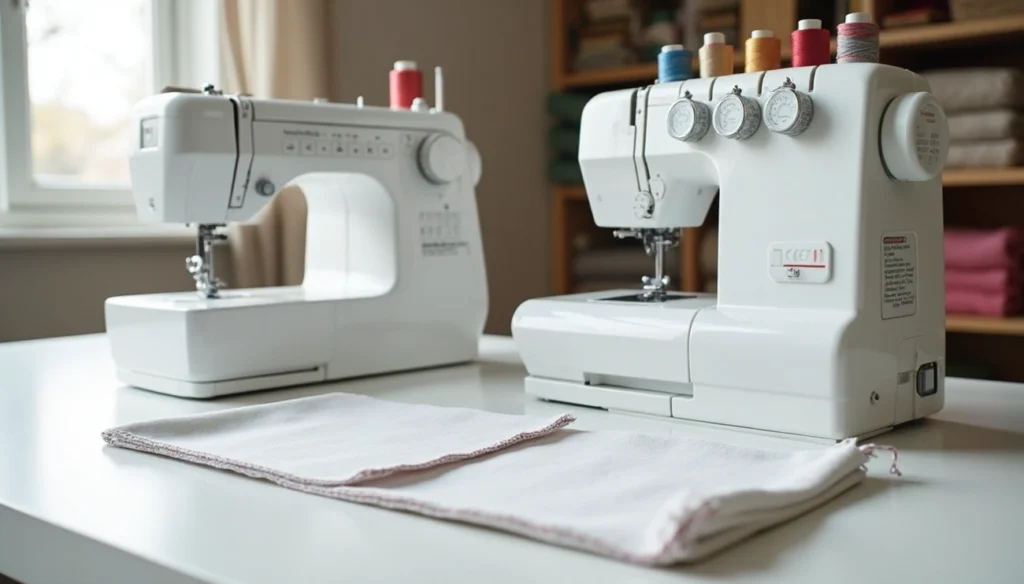

You don’t need a serger to sew, but it offers faster seams, professional finishes, and better edge protection. A standard sewing machine handles most tasks, but a serger is essential for frequent knit projects or high-volume garment construction due to its speed and multi-thread capabilities.
What does a serger sewing machine do?
A serger machine stands out as a specialized tool that performs multiple functions in one swift operation. Unlike regular sewing machines, a serger (sometimes called an overlocker) trims fabric edges, sews seams, and finishes edges all in a single pass. This specialized machine works at remarkable speeds—up to 1700 stitches per minute compared to a conventional machine’s 600 stitches per minute.
How a serger differs from a regular sewing machine
The fundamental difference between sergers and regular sewing machines lies in their construction and purpose. While standard sewing machines typically use one or two threads to create lockstitches, sergers employ three to five threads to form overlock stitches that wrap around fabric edges.
Furthermore, sergers feature built-in cutting blades that trim excess fabric as they sew. This knife or cutting mechanism moves at the same speed as the needle, creating clean edges before the thread secures them.
Since sergers only sew along the left side of the needles, you must plan projects accordingly. They’re more specialized than conventional machines but offer unparalleled efficiency for specific tasks.
What is a serger used for in garment making
Primarily, sergers excel at:
- Finishing raw edges to prevent fraying
- Creating stretchable, durable seams for knit fabrics
- Sewing and simultaneously trimming excess fabric
- Making narrow or rolled hems quickly
- Adding decorative edges and special finishes
Sergers particularly shine when working with knit or stretchy fabrics. The overlock stitch has built-in stretch, making it ideal for t-shirts, activewear, and swimwear. Moreover, sergers can construct entire garments or work alongside regular machines for optimal results.
Understanding overlock stitches and seam finishing
The overlock stitch forms when needles penetrate the fabric while looper threads wrap the raw edge. These threads create a binding that prevents fraying and adds durability. Most home sergers offer both 3-thread and 4-thread capabilities.
A 3-thread overlock works well for finishing lightweight fabrics or simple edge finishing, whereas a 4-thread overlock (using two needles) creates stronger seams ideal for medium to heavy fabrics or areas under stress.
Notably, some advanced sergers offer specialized stitches like flatlock seams, rolled hems, and even decorative wave stitches. These stitches can be used both functionally and decoratively, elevating the look of handmade garments to professional quality.
When do you actually need a serger?
Many sewists wonder exactly when they should reach for a serger instead of their regular machine. Let’s explore the specific situations where a serger becomes truly valuable.
Sewing with knits and stretchy fabrics
Sergers truly shine when working with stretchy materials. The overlock stitch creates elastic seams that won’t break when the fabric stretches, making sergers ideal for crafting leggings, t-shirts, and swimwear. Unlike regular machines, sergers feature differential feed—two sets of feed dogs that work independently, preventing fabric from stretching out of shape during sewing.
For knits, setting your serger to a 4-thread overlock provides mechanical stretch while simultaneously finishing edges. Turn on differential feed to ensure both layers of fabric get pulled through evenly, eliminating those frustrating wavy, stretched-out seams.
Creating professional-looking seams
Nothing says “homemade” like fraying, unfinished edges. Sergers create clean, polished edges that rival store-bought apparel. They’re especially valuable for:
- Denim and heavy-duty fabrics prone to fraying
- Garments that need durable, long-lasting seams
- Projects where the inside should look as good as the outside
The 4-thread safety stitch (with two needles) creates exceptionally secure seams, perfect for medium to heavy fabrics or areas under stress.
Saving time with combined stitching and trimming
One of the biggest advantages of sergers is efficiency. They trim, stitch, and finish fabric edges all at once—dramatically speeding up your sewing projects. For high-volume sewing or items with long seams (like curtains or tablecloths), this time-saving feature is invaluable.
Making rolled hems and decorative edges
Creating professional-looking rolled hems on napkins, scarves, or garment edges becomes effortless with a serger. By removing the stitch finger and adjusting settings, you can create beautiful, narrow hems in minutes.
Beyond functional finishes, sergers can create decorative edges like lettuce edging (wavy, frilly edges popular on children’s clothing) or picot edges for delicate fabrics. Using specialty threads in the loopers—such as Wooly Nylon or other decorative threads—adds unique, eye-catching finishes impossible to achieve on standard machines.
Is a serger worth it? Pros and cons explained

Deciding whether to invest in a serger means weighing its impressive capabilities against potential drawbacks. After all, no machine is perfect for every situation. Let’s explore if a serger belongs in your sewing space.
Pros: speed, durability, and clean finishes
The speed advantage alone makes many sewists fall in love with sergers. These machines operate at an impressive 2000+ stitches per minute—roughly twice as fast as standard sewing machines (650-1000 stitches per minute). This difference becomes significant when tackling large projects.
Beyond speed, serged seams offer exceptional durability. The stretchy overlock stitch creates robust, flexible seams that withstand intense stretching without breaking. One sewist reports her serged Hudson pants holding up perfectly after daily wear and multiple washes.
Finally, the professional finish achieved with a serger is unmatched. The clean edges resist fraying and give handmade items that coveted store-bought appearance. For sewists who sell their creations, this polished look proves invaluable.
Cons: cost, space, and learning curve
First off, sergers require a financial commitment. Entry-level models start around $200, with premium options reaching $800 or more. Additionally, they consume substantial amounts of thread—requiring four large cones that must often be purchased separately.
Space considerations present another challenge. For those without dedicated sewing rooms, finding room for an additional machine can be problematic.
Perhaps most daunting is the learning curve. Even experienced sewists often need time to master serger operation. As one user confesses, “I thought buying a serger was going to be so useful… but I use it around 1/10th of the time I use my regular sewing machine”.
Threading challenges and noise factor
Threading consistently ranks as the top frustration among serger owners. Each thread must follow a specific path, generally in this order: upper looper, lower looper, right needle, left needle. If one thread breaks mid-project, you’ll likely need to rethread the entire machine.
Noise presents another consideration. Sergers operate significantly louder than standard machines, potentially limiting when you can sew in shared living spaces.
Lastly, the cutting blade that makes sergers so efficient also creates risk—once fabric is cut, there’s no going back. One sewist admits, “I’ve cut plenty of holes in my garments because I was not paying enough attention”.
Can you sew without a serger? Alternatives and tips
Despite the advantages of sergers, millions of sewists create beautiful garments without them. Indeed, regular sewing machines offer several effective alternatives for finishing seams and working with stretchy fabrics.
Using zigzag or stretch stitches on a regular machine
Most standard sewing machines include zigzag stitches that work wonderfully for finishing raw edges and sewing stretch fabrics. For best results with zigzag finishes:
- Set your machine to a short, medium-wide zigzag (typically 2.4-2.5mm length and 3-3.5mm width)
- Stitch close to—but not over—the fabric edge
- Consider using an overcast or overlock foot for your machine
For knit fabrics, look for specialized stretch stitches on your machine. The lightning bolt stitch creates seams with built-in stretch while appearing almost like a straight stitch. Nevertheless, even a narrow zigzag works well—simply decrease the width to create a compromise between a straight stitch and a zigzag.
Many sewists successfully use a triple zigzag (or tricot stitch) for lightweight knits to prevent the “tunneling” effect regular zigzags sometimes create.
Finishing seams with pinking shears or bias tape
Pinking shears create zigzag cuts along fabric edges, reducing fraying by causing fabric to fray in small rather than long pieces. Although this method doesn’t completely prevent unraveling, it works effectively for fabrics that fray minimally or garments that won’t be machine-washed frequently.
For a more durable finish, rayon seam binding or bias tape creates beautiful bound edges. This technique involves sandwiching raw edges inside the tape, creating clean finishes that will never unravel. In contrast to serged edges which might deteriorate after multiple washes, bound edges maintain their integrity.
When a serger becomes optional vs essential
A serger remains optional unless you frequently sew knits, need professional finishes for selling handmade items, or value time-saving features. First-time sewists, occasional crafters, or those working primarily with stable woven fabrics can absolutely create beautiful projects using regular machines.
Even professional seamstresses worked without sergers for decades before they became widely available. With practice and the right techniques, zigzag stitches and other alternatives can produce results nearly indistinguishable from serged finishes.
Conclusion
Deciding whether to add a serger to your sewing arsenal ultimately depends on your specific needs and preferences. Throughout this exploration, we’ve seen how sergers excel at creating professional finishes, handling stretchy fabrics, and saving significant time with their ability to trim, stitch, and finish edges simultaneously.
However, regular sewing machines certainly remain versatile workhorses for most projects. Zigzag stitches, pinking shears, and bias tape offer practical alternatives for those not ready to invest in a serger yet. These techniques have served generations of sewists effectively before sergers became commonplace.
Key Takeaways
Whether you need a serger depends on your sewing habits, project types, and quality expectations. Here’s what experts recommend considering:
• Sergers excel with knits and stretchy fabrics – The overlock stitch provides built-in stretch that won’t break when fabric stretches, making them essential for activewear and t-shirts.
• Time savings are significant – Sergers trim, stitch, and finish edges simultaneously at 2000+ stitches per minute, completing projects in half the time of regular machines.
• Professional finishes justify the investment – Clean, fray-resistant edges give handmade items a store-bought appearance, especially valuable for sewists selling their creations.
• Regular machines offer viable alternatives – Zigzag stitches, pinking shears, and bias tape can achieve similar results for occasional sewists or those working primarily with stable fabrics.
• Consider your sewing frequency before buying – Entry-level sergers start at $200 plus threading complexity, making them worthwhile mainly for frequent knit sewists or those prioritizing professional results.